
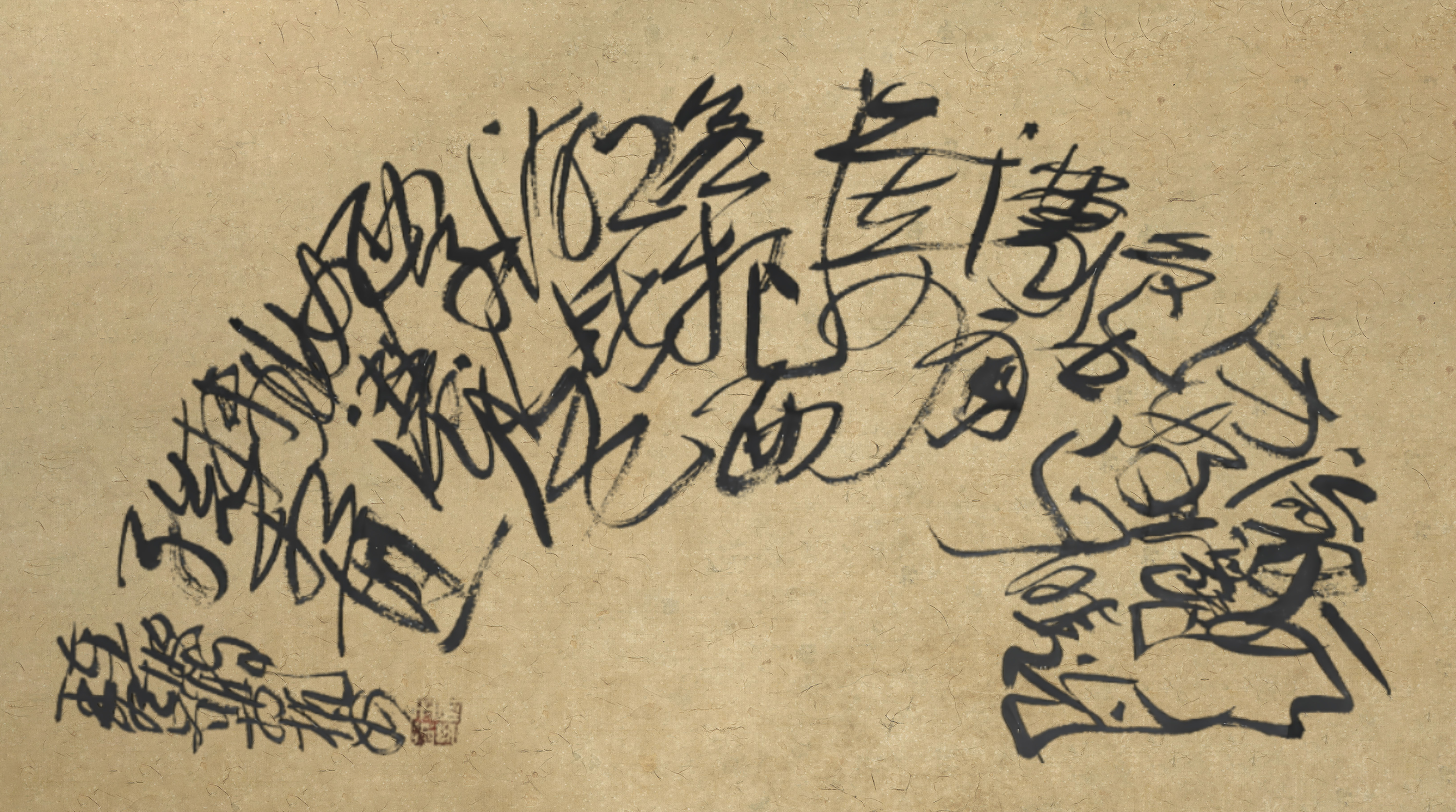
Wang Dongling Chaos Script artwork inspired by Su Shi’s West Lake poem. Image provided by the client for this blog draft.
Review note: This draft is based on the provided text and description. It does not authenticate the artwork. For sales, exhibitions, or publication, please add provenance, dimensions, year of creation, high-resolution signature/seal details, and artist or gallery documentation.
Few lines are more closely associated with Hangzhou than Su Shi’s famous couplet: “If one were to compare West Lake to Xi Shi, whether lightly or richly adorned, she is always fittingly beautiful.” The lines come from Drinking on the Lake: First Clear, Then Rain, one of Su Shi’s best-known poems on West Lake.
In the work discussed here, the contemporary calligrapher Wang Dongling rewrites this classical line through his distinctive “Chaos Script” style. The poem remains present, but it no longer functions only as readable text. It becomes a field of movement: overlapping strokes, dense ink, rapid gestures, and shifting spaces between legibility and abstraction.

Portrait of Su Shi. Public-domain reproduction via Wikimedia Commons.
The full poem reads:
The shimmering water is beautiful in clear weather;
The misty mountains are also wondrous in rain.
If one were to compare West Lake to Xi Shi,
Lightly or richly adorned, she is always fittingly beautiful.
The poem is generally dated to around 1073, during Su Shi’s service as Assistant Prefect of Hangzhou. At that time, Hangzhou was already a major city of the southeast, known for its urban prosperity and refined landscape culture. Su Shi wrote many poems on West Lake during his years in Hangzhou, but this short quatrain became the most enduring.
The title, First Clear, Then Rain, is essential. The poem records a changing scene: sunlight on the water, then rain over the mountains. The first two lines describe what the poet sees. The final two lines transform the view through metaphor. West Lake becomes Xi Shi, the legendary beauty of ancient Yue.
The comparison was so successful that West Lake later came to be known as “Xizi Lake,” the Lake of Xi Shi.

Calligraphy attributed to Su Shi. Public-domain reproduction via Wikimedia Commons.
Su Shi’s relationship with Hangzhou was not merely literary. He first served there from 1071 to 1074. Later, when he returned as prefect, he took part in the dredging and restoration of West Lake and became associated with the construction of the causeway later known as Su Causeway.
For this reason, Su Shi’s West Lake is not simply a poetic landscape. It is a lived urban and cultural space: water, hills, rain, boats, banquets, roads, bridges, officials, monks, writers, and local residents all belong to its historical reality.
The famous comparison between West Lake and Xi Shi is also geographically meaningful. Xi Shi was traditionally associated with the ancient state of Yue, in the region of present-day Zhejiang. By comparing West Lake to Xi Shi, Su Shi did more than praise beauty. He connected landscape, regional memory, and classical imagination.
The key word in the poem is “fitting.” West Lake does not need one perfect condition. It is equally beautiful in different states. This is the essence of the poem’s elegance.

West Lake in clear weather, corresponding to “the shimmering water.” Photograph by Louisa Salazar, Wikimedia Commons.

“Twin Peaks Piercing the Clouds” from Ten Scenes Around West Lake, used to echo the poem’s misty mountain imagery. Public-domain image via Wikimedia Commons.
Wang Dongling, born in 1945 in Rudong, Jiangsu, is one of the most important figures in contemporary Chinese calligraphy. Long associated with the China Academy of Art in Hangzhou, he is known for combining rigorous traditional training with experimental approaches to scale, performance, abstraction, and public writing.
His significance lies not only in his command of traditional brushwork, but in his sustained question: What can calligraphy become in the modern visual world?
For Wang, calligraphy is not limited to writing characters on paper. It can be text, line, gesture, bodily movement, spatial event, and abstract image.
His “Chaos Script” is one of his most recognizable contributions. Built upon the structure of cursive script, it disrupts the conventional order of rows and columns. Characters overlap, lines interweave, and the text moves toward the edge of legibility. The viewer can sense the poem, but cannot simply read it in the ordinary way.
This is not random scribbling. Its apparent disorder depends on deep training in brush technique, cursive structure, rhythm, and composition. In Chaos Script, disorder is controlled; freedom is built upon discipline.
There is a strong inner connection between Su Shi’s poem and Wang Dongling’s visual treatment.
Su Shi writes about transformation: clear weather and rain, water and mountain, brightness and mist, light makeup and rich adornment. Wang’s Chaos Script also lives in transformation: between text and image, readability and abstraction, order and disorder, tradition and contemporary art.
In the work, dense clusters of strokes may recall mist pressing over hills, while open areas suggest the breathing space of water. The movement of the brush releases the poem from fixed characters and turns it into rhythm. Su Shi turned West Lake into a living beauty; Wang turns Su Shi’s line into a visual field.
This is where contemporary calligraphy becomes more than decorative quotation. It does not merely repeat a classical poem. It reactivates the poem’s internal energy.
Nearly a thousand years separate Su Shi and Wang Dongling. One shaped West Lake through language; the other reshapes language through line. One captured the beauty of changing weather; the other pushes writing toward a changing visual experience.
The line “lightly or richly adorned, she is always fittingly beautiful” continues to be written because it is not closed. It is not a fixed compliment. It is a theory of beauty in change.
West Lake changes between sunlight and rain. Poetry changes through reading. Calligraphy changes between tradition and experiment.
Wang Dongling’s Chaos Script allows this classical line to leave the textbook, the stele, and the tourist slogan. It returns the poem to brush, body, ink, and visual experience.
It is not a simple reproduction of Su Shi. It is a response across time.

