Tang molded Heavenly Horse Brick. Collection of Dunhuang Museum; museum catalogue no. 0757.
The Heavenly Horse Brick from Dunhuang is an unusually accessible object for readers approaching Chinese art and history. It does not require a long explanation before it becomes visually compelling. A horse raises its head, lifts its body, throws its legs into the air, and seems ready to leap out of the brick surface. Its first appeal is not symbolism, but motion.
This Tang-dynasty molded brick was collected from the Laojun Hall site at Sanwei Mountain near Dunhuang. According to the Dunhuang Museum, the brick measures 42 cm in length, 19.5 cm in width, and 8 cm in thickness. It is basically complete and is classified as a first-grade cultural relic. The horse is rendered in relief: head lifted, neck ornamented with ribbons, four legs airborne, tail rising behind it. Some descriptions also mention wing-like decoration on the shoulders. This is not a purely naturalistic horse. It is a horse transformed into an image of speed and wonder.
The idea of the tianma, or “Heavenly Horse,” has deep roots in Chinese historical memory. During the reign of Emperor Wu of the Western Han dynasty, fine horses from the western regions became objects of intense interest. They were valued not only for transport and warfare, but also for their association with auspicious signs and distant lands.
Historical sources preserve several related but distinct strands of the Heavenly Horse tradition: horses from Wusun, the famous horses of Dayuan in Ferghana, and the legendary horse associated with Wowa Water near Dunhuang.

Landscape at Yangguan, Dunhuang, used here to connect the Heavenly Horse tradition with the geography of the Dunhuang region. Photograph by Hiroki Ogawa, Wikimedia Commons, CC BY 3.0.
The Records of the Grand Historian mentions that Emperor Wu obtained a divine horse from Wowa Water and composed a song in its honor. One famous line evokes the horse as descending from Heaven, sweating red, with foam like cinnabar. Such language blends real horses, frontier geography, court ritual, and poetic imagination.
For accuracy, one should be careful with later legends. It is safer to say that, during Emperor Wu’s reign, a remarkable horse associated with Wowa Water near Dunhuang entered historical and literary memory, and was later connected with the tradition of the Heavenly Horse Song. The idea that the emperor personally raised horses there or dreamed of the Heavenly Horse should be treated as legend rather than confirmed fact.
Although the Dunhuang Heavenly Horse Brick is a Tang-dynasty object, it carries an older Han-dynasty memory. This long continuity is part of its appeal.
The Tang dynasty was a great age of horse imagery. Horses appeared in tomb figures, murals, sculpture, and decorative patterns. They were connected with travel, military culture, aristocratic life, hunting, polo, and exchange across Central Asia. Tang artists often emphasized volume, energy, and posture rather than quiet stillness.

Tang-dynasty sancai horse, used as a comparison for Tang interest in powerful equine imagery. Photographed at the Cincinnati Art Museum by Daderot, Wikimedia Commons.
The Dunhuang Heavenly Horse Brick pushes this visual language further. The horse does not stand on the ground. It flies. The ribbons and lifted tail intensify the sense of direction. The wing-like details identify it not merely as a horse, but as a supernatural horse.
Its beauty does not lie in anatomical precision. It lies in captured energy. In much of Chinese animal art, the goal is not only likeness, but spirit. This brick does not record the body of a horse; it distills the sensation of speed.
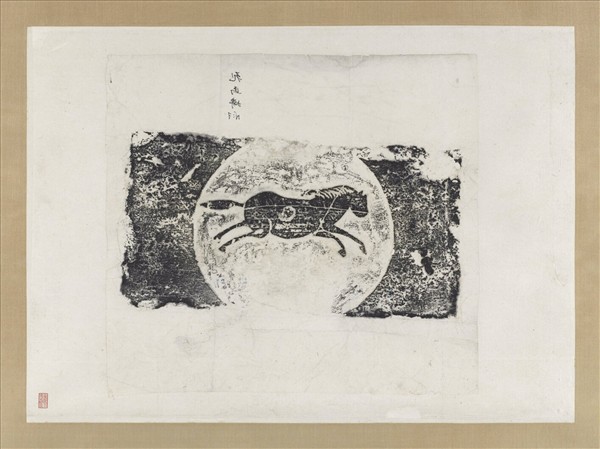
When we speak of the Dunhuang Heavenly Horse Brick Rubbing, we are usually referring not to the original brick, but to an ink impression taken from its relief surface.
Rubbing is an important traditional method in China for recording inscriptions, pictorial bricks, carved stones, and decorative patterns. Paper is pressed against the surface, and ink is applied so that the raised areas and textures emerge as a black-and-white image.
Comparative rubbing: Han Flying Horse illustrated-brick rubbing. Used to show ink texture and the conversion of relief imagery into a graphic impression. National Palace Museum, Taipei.
A rubbing is not a mechanical copy. It preserves pressure, texture, wear, broken edges, and the uneven surface of the original object. The sculptural body of the brick becomes a graphic image. Clay and fire are translated into paper and ink.
Clay and fire are translated into paper and ink. The object becomes a surface, and the surface becomes motion.
This is why the Heavenly Horse rubbing works so well in contemporary visual culture. It has the authority of an ancient object and the clarity of a modern graphic form. Its silhouette is strong, its movement immediate, and its surface rich with historical texture. It can be read as an artifact, but it can also become a motif for textiles, tea mats, exhibition posters, interior decoration, or cultural products.
The power of the Dunhuang Heavenly Horse Brick does not depend on turning it into a fixed myth. Its value lies in the layered relationship between history and image: Han-dynasty records and legends of the Heavenly Horse, Tang-dynasty molded craftsmanship, Dunhuang’s position as a Silk Road cultural site, and the later aesthetic transformation of the brick into an ink rubbing.
It is both artifact and image. It belongs to history, yet still preserves imagination.
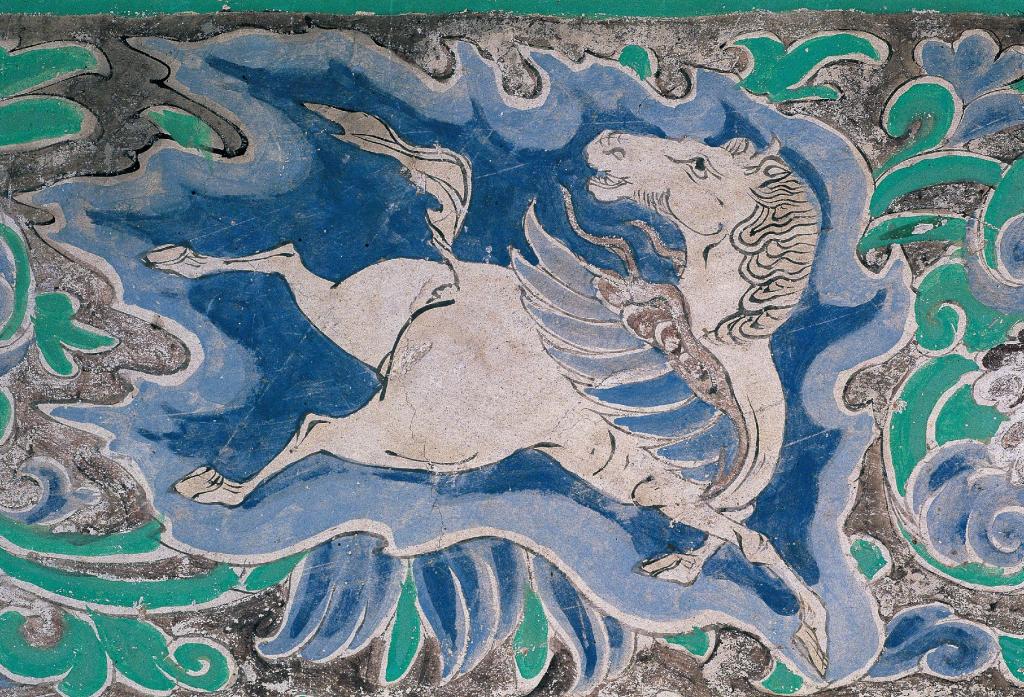
Winged horse at Yulin Cave 10, showing a broader Dunhuang-area visual tradition of flying or supernatural horses. Xinhua / Xinhua Silk Road.
A horse appears first in frontier memory, then in imperial song, then in Tang brickwork, and finally in the dark ink of a rubbing. It does not need excessive interpretation. One only needs to look at its raised head, airborne legs, and flying tail to understand why such a creature could be called a Heavenly Horse.